Showing posts with label CANADA. Show all posts

St. Patrick's Day


St. Patrick's Day is a holiday celebrated on 17 March. St. Patrick's Day was made an official feast day in the early seventeenth century and during that time it had gradually become more of a celebration of Irish culture. The day generally involves parades, festivals and wearing green.


In 2004, the CelticFest Vancouver Society created an annual festival in downtown Vancouver to celebrate the Celtic Nations and their culture. This event, which includes a parade, occurs the weekend closest to St. Patrick's Day. The parade includes dozens of marching bands/pipers in traditional costume, unicyclists, stilt walkers, Irish and Scottish dancers, multicultural floats, music performers and more. After the parade, there are plenty of performances on the street.


This St. Patrick's Day, the TV media in Vancouver was using advertising from a Guinness's 2012 Arthur's Day spot. This Guinness's “Paint The Town Black” ad, showed Romanians going berserk, dousing anything they can get their hands on in pots of black paint. This music was performed by the Romanian band “Fanfare Ciocarlia”. To see the video, click here.

Their musical style stems primarily from the traditions of Romanian folk dance music, but they also borrow freely from SERBIAN, Bulgarian and Macedonian musical styles. I wonder why Guinness used this song for the soundtrack instead of Celtic music. Also, if you see the next video about the Guča Festival in Serbia, you will see where this Romanian band found inspiration for this song. To see the video, click here.

Also, approaching St.Patrick’s Day, a ad coincided for the new Joe Fresh Spring 2013 campaign. Music for this ad was performed by the United Kingdom band “Sam and the Womp”. Their music mixes trumpets inspired by traditional Serbian music, aka “trubači”, with modern electronic and dance elements. So, it’s about Guča Festival again. Serbia's famous trumpet festival is held every year at the beginning of August. Although Guča has a population of only 2,000, more than 600,000 people usually attend the Guča festival each year. People from abroad also come to enjoy the music and festivities. To see a sample of the music from Guča, click here.

5 comparable facts about 2 new bridges on opposite sides of our planet

Vancouver, Canada 

1.
Canada: Port Mann Bridge near Vancouver is a steel tied arch bridge and its current traffic volume is 127,000 trips per day. Approximately eight percent of the traffic on the Port Mann bridge is truck traffic. 

Serbia: The new Ada Bridge is a cable-stayed bridge over the Sava river in Belgrade, Serbia. The bridge pylon is located on the tip of the island which has been reinforced with large amounts of concrete and has been slightly enlarged to provide stronger foundations. 

2.
Canada: Total length: 2,020 m  ;  Width: 65 m  ;  Height: 163 m. The bridge is the longest arch bridge in Canada and 15th longest in the world. This is the widest bridge in the world.

Serbia: Total length: 996 m  ;  Width: 45 m  ;  Height: 200 m. This is the largest bridge surface in the world suspended by just one pylon.

3.
Canada: Construction began in 2009 and the bridge opened on September 18, 2012. During construction of the replacement bridge, a crane collapsed on February 10, 2012 causing a 90-tonne concrete section of bridge decking to drop into the water below.

Serbia: Construction began in 2008 and the bridge opened on January 1, 2012. There were no construction accidents during construction of this bridge.

4.
Canada: The old orange bridge, a symbol of that area, will be eventually torn down. This is very sad and unacceptable to me. A bridge should definitely outlast its builders (it was  built in 1964).

Serbia: Not one old bridge will be torn down because of this new bridge.

5.
Canada: Cars are now tolled $1.50 each way and will increase to $3 on March 1st  2013. Cars pulling trailers or light trucks pay an introductory rate of $4.50 and also will increase to $6 on March 1st  2013.

Serbia: The bridge is free to use.

Belgrade, Serbia 


Granville Island, Vancouver


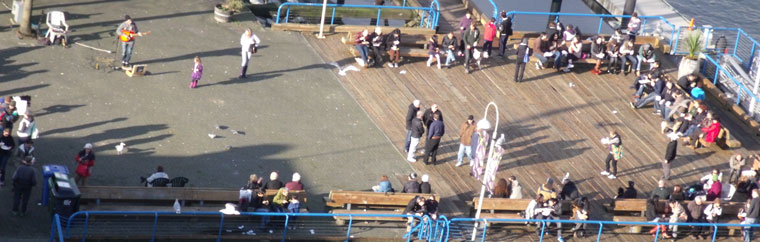
This island is rich in North American history. Its industry boomed in the ‘20s and ‘30s but after the war many of the large plants left. It remained unnoticed until 1973 when the federal government got involved. Most of the remaining industries were persuaded to leave but the  buildings were kept and given a facelift. Granville Island is now a hub of color and creativity, producing things like pottery, plays, children’s toys and chocolates. The heart of Granville island is the Public Market where specialty foods, fresh from the farm, overflow from every stall. It is a people place. It is not too trendy or touristy and there is more to do than just shop. In the courtyard people enjoy lunch on their laps, entertained by performers from the Folk, Jazz, Evergreen and Comedy Festivals. One can spend hours wandering the craft and art galleries, enjoying the waterfront scenes and simply being part of the easygoing atmosphere. You can purchase gifts that are common to  B.C., such as native masks or jewellery, locally made pottery or weaving. The Island has boat rentals and there are a few houseboat communities where the  residents of the island live.  As well as the many take-out stands in the market (you can get fish and chips, deli fare, Japanese ...) there are restaurants on the island. Two companies run small ferries from downtown to the island. Today was cold and the Canadian football championship game is scheduled to start soon but there were still a lot of people there. We live just across the bridge from Granville Island and we like to come there even just for a short visit.


R.I.P. Summer of Love


After celebrating the 40th Anniversary in 2009 the longstanding Kitsilano Summer of Love Festival (formerly known as Hippie Daze) is no longer. Even though the festival was small, it was nicely put together. It will be missed by the locals since it did bring money into the community even if it was just for a weekend.


The Pacific National Exhibition (PNE) in Vancouver

It was originally classified as an agricultural fair but it is much more. The PNE has been held every summer since 1910. This fair is one of the largest in North America. It is an enormous summer fair with more than 50 rides and attractions, nightly concerts, live performances, agricultural and animal displays, games and food. The PNE is very crowded with long lineups for the food and rides. Half of the time you are at playland you are in the lineups. Many people come to the fair for the food. They love the deep fried stuff, hot dogs, mini donuts, Indian food, funnel cakes, seafood, pizza and more. I’m not so excited about that because I don’t like that kind of food but I like to try everything. Bring cash because most vendors only accept cash.

This playland is really expensive. For a park that is definitely showing its age, you pay a lot of money for the privilege of going on some very old rides. The PNE is more for the kids and for their parents who can’t say NO to them when they are little. It is a great summer job for students. In Toronto, Ontario there is a comparable summer fair known as the Canadian National Exhibition (CNE).


Stanley Park, Vancouver, Canada

Stanley Park is very popular in Vancouver, Canada. This park is very large (400 ha). While it has the lawns, picnic tables, civic monuments and gardens that you usually find in a civic park, it also has the wilderness and the ocean. The ocean almost encircles the park and along the shore are sandy beaches and a sea-walk that offers spectacular views. Stanley park is one of the largest inner-city parks on the North American continent and it is a mere 15-minute walk from downtown. It is not advisable to take your car into the park on summer weekends unless the weather is bad. If you do drive around the park, remember that vehicle traffic runs one way, counterclockwise and the same rule is for cyclists too. Park attractions are well marked. The park is a peninsula rimmed by a seawall. The seawall path is clearly divided - one side for pedestrians and the other side for cyclists.

Totem poles represents different BC First Nations.


Girl in a Wetsuit statue. This is similar to the famous mermaid statue in the Copenhagen Harbour.


Lions Gate Bridge marks the halfway point of the walk around the park.


Siwash Rock is a popular stop for cyclists, anglers, walkers and joggers. Picture right is Siwash Rock together with Third Beach when the tide is in.


The seawall, a 8.8 km (5½ mile) paved path along the shore of Stanley Park, is a wonderful bike ride because of the spectacular views. I have noticed that a lot of tourists paid more attention to the traffic then enjoying the view. The seawall is divided in two: one side is for cyclists, the other for pedestrians. The cyclists must ride counterclockwise around the park and must dismount at a few designated busy spots. If you want to ride on the weekends when the park is very busy, you have to be patient and careful. I’m from Serbia but in Vancouver I don’t feel like a tourist, so I don’t use the busy tourists paths. Not only tourists but also Vancouverites avoid going  deep into Stanley Park’s rainforest because they don’t feel safe. People feel more comfortable with others more then being alone in the middle of the wilderness. The natural rainforest in the park has lot of paths that I used a lot  but not anymore because I gave my bicycle away as a present. For the next few winter months I wouldn’t need it and after that I would be going to Serbia anyway.


Serbian Green Market - Pijaca

The tomato originates from Peru where it grew wild. There still are 8 species of wild tomatoes in the Andes. After colonization of the continent, tomatoes came to Europe. In Europe, it was thought that its fruit was toxic and used only as an ornamental plant. The Serbian word for tomato is “paradajz”. It was believed that tomatoes lead to your death so the tomato plant was called paradajz (paradise). It is roughly pronounced “paradise” and when you taste one that is what it tastes like. The Mediterranean climate proved to be ideal for this plant. The tomatoes bought in North America at a supermarket have a plastic taste even when they are “organic”. They look lovely but lack the taste of a garden grown with love and care.

Tomatoes on our balcony
We decided to have our own tomato garden on our balcony in a heart of downtown Vancouver, Canada. We bought the seeds, pots, soil, tools and were looking forward to “the back breaking labor of gardening.”  It took a long time before the flowers came out indicating we should get the tomatoes soon but it seemed like forever before we saw the first tomato .We had nice tall plants, the tomatoes looked good and they smelled good when they finally arrived in August after planting them in March. We were hoping that our tomatoes will have a more natural taste but they were was exactly like from the store - tasteless. Maybe this is just not the right climate for this plant.

In Serbia, every town has a green market (pijaca) with real organic products. Products are often grown in the area immediately around the city. Open air markets are a tradition but also an everyday necessity for many. The variety of goods for sale at the average market is always impressive. It is possible to get a great bargain on most products, if you’re a shrewd negotiator. Pijaca is a vibrant and exciting place to explore even if you aren't looking to buy.
If you’re in Serbia you have to eat a šopska salata. It’s great salad, with nothing but tomatoes, cucumbers, onions and hot peppers, topped with a Serbian cheese that tastes similar to grated feta. In Serbia, one šopska is large enough to be dinner, but actually it is just an appetizer.

Niagara Falls in the winter


Visiting Niagara Falls in the winter is a different experience. While the thunder and spray of the falls is probably the same as in summer, the winter wonderland around the falls gives it a totally different look and feel. It's so cold that the spray from the falls freezes on the trees and branches. You will witness the clinging spray of the Falls as it  blankets the trees and the rocks. Lake Erie, which drains into the Niagara River, is large but rather shallow. By the end of December the entire lake surface is frozen.

Interesting shapes can be seen thanks to winter:

On that day the Olympic Torch was at Niagara Falls on its journey across Canada to Vancouver and I had it in my hands 3 months before the start of the Winter Olympic Games:

If Nik Wallenda (the man who walked over the Falls on a tight rope in 2012 from  USA to Canada) comes to mind when someone mentions Niagara Falls - then you need to read my post about NIKOLA TESLA. At Niagara Falls you can find a monument of this Serbian-American inventor. Nikola Tesla designed the first hydroelectric power plant at Niagara Falls, which started producing electrical power in 1895. This was the beginning of the electrification of the United States and the rest of the world.


OK, that was it, I’m getting cold ... bye for now


During the Great Depression (1930s) Gastown was the centre of the Vancouver's drinking life

Steam clock in Gastown
The first Gastown BBQ & Chili Festival happened this Saturday and Sunday. One street is closed for live music, a block-party atmosphere and a “food competition”. We went there and figured out we were lucky that we did not hype up this event to visitors from out of town who may have come with us. This “festival” was so sad and it could be not only the first but the last too. Happyfully, Vancouver has a lot of other good festivals. Today, I would rather write about a part of the city where this not-worth-mentioning-festival happend.

The area was originally called Gassy's after the saloon proprietor Gassy Jack Deighton. His saloon was very popular among the nearby workers and they built their houses near that area. After being rebuilt from the fire in 1886 the village was renamed Gastown.
Gastown found new life as the centre of the city's wholesale produce distribution until the Great Depression in the 1930s. It also was the centre of the city's drinking life (there were 300 licensed establishments).
After the Depression,  Gastown was a largely forgotten neighbourhood of the larger city. The city grew more and more westward and changed its name to Vancouver, while Gastown became known as Old Vancouver. Under the pressure of the local community to preserve Gastown, it was designated a historic area by the provincial government in February 1971, and the old buildings were saved from the wrecker.
Today, Gastown is a famous tourist site. It is an excellent area for walking tours  because it is close to most downtown hotels, shops and attractions. The Gassy Jack statue stands proudly on a whiskey barrel, his first market product after opening his saloon. The renovated Gastown, with its cobblestone streets and restored Victorian buildings, is a pleasant place for strolling. It also contains some nice malls together with a lot of souvenir shops, First Nations galleries and street vendors.
One of tourist attractions in Gastown is the unique steam clock. The Gastown Steam Clock was the world's first steam clock and was originally built to cover a steam grate as a part of Vancouver's distributed steam-heating system. The clock was built as a way to harness the steam and to prevent street people from sleeping on the spot in cold weather. The 2 ton weighing clock whistles every 15 minutes.

Vancouver - New York - Toronto
Hotel Europe is a six-story heritage building located in the Gastown area. The building was commissioned by hotelier Angelo Calori and built in 1908 - 1909 by Parr and Fee Architects. Situated on a triangular lot, the building is designed in the flatiron style. Canadians are so proud of Hotel Europe, their “pioneer Canadian architecture”, but actually the architects copied the design from New York’s Flatiron building.  It was the first reinforced concrete structure built in Canada and the earliest fireproof hotel in Western Canada. The Europe was one of Vancouver’s finest hotels. The basement housed one of the city’s most popular bars and it was here that much of the business of early Vancouver was conducted. It is shame but the city decided in 1983 to convert the  building into low income housing units.
The Hotel Europe was one of the filming location for the Canadian suspense movie “The Changeling” from 1980 (not “Changeling” directed by Clint Eastwood from 2008). In the movie, the building housed the Seattle Historical Society.  Some scenes are set on its roof terrace.
I want  to mention that famous New York's Flatiron Building (1902) was not the first modern building of its triangular ground plan. Before this one in New York, Canadians had already built The Gooderham Building in Toronto (1892).


Hollywood Runaway Production

We gratefully acknowledge the cartoon contribution from the Atlanta Journal-Constitution's Pulitzer Prize winner
Mike Luckovich

In the previous post I mentioned one alley in Victoria, BC used in a scene in an American movie. This is not an isolated case. Runaway production is a term used by the American film industry to describe film making and television productions that are "intended for initial release/exhibition or television broadcast in the US, but are actually filmed in another country." In Southern California, the studios have highly efficient sound stages and an abundance of skilled technicians, but the unions' work rules make it extremely expensive to shoot exteriors. Filming in cities such as New York and Chicago are expensive.  They even shoot  US tourist promos up in Canada. Movies are like hookers,they  go to where the money is. For American film producers a low Canadian dollar is the solution to cut filming costs.

Producers found that Vancouver could double for middle America, Toronto could stand in for New York City and Calgary can pass for the American West. Sometimes script adjustments are required to accommodate the cold reality of the North. When Canadians go to see Hollywood films they often get the bonus entertainment of trying to determine what parts of Toronto, Vancouver and Montreal the directors have chosen to represent American cities.
Americans want to see American cities. There’s nothing wrong with faking locations. It’s something Hollywood has always done and always will (like landing on the Moon ??) .  Sometimes a movie is filmed in Canada to double for America or sometimes a movie is filmed in America to double for other country or planet. Movies, after all, are in the business of make-believe.

These are just a few:


CANADA: Victoria BC

Victoria is the capital city of British Columbia, Canada and is located on the southern tip of Vancouver Island off Canada's Pacific coast. Victoria is about 100 kilometres from BC's largest city of Vancouver on the mainland and the same from the city of Seattle, Washington. Because this city is on an island the two most common ways to get there is either by plane or ferry. The best way to get to Victoria is to walk on or drive your car on to the ferry. If you coming from Vancouver and don’t want to drive, the public transportation is great. Whether you use local buses or the skytrain to get to the ferry, all of them are modern and clean and you don’t have to walk far.  Travelling on the ferry is like taking a mini cruise. The ships are very clean and have conveniences such as restaurants, gift shops and kid’s playroom. You will see the Gulf Islands up close, bathed in their rugged coastal beauty. Buses from the ferry to downtown Victoria are usually double decker which makes scenery-watching easier.

The official web sites and locals writing about Victoria are very excited about how much there is to do. The truth is that it really depends on what you like but you can have fun doing anything if you come with a good companion. Almost everything is overpriced and overrated there. I do have to admit that the downtown is picturesque with featuring waterfront paths, charming shops, restaurants and heritage buildings. Despite Victoria’s reputation as a tourist destination, there still is the same problem with loitering and panhandling in the downtown core. Victoria's Inner Harbour is in the heart of downtown. You can see (and buy) the arts and crafts displays along the lower causeway. Musicians and magicians are everywhere entertaining the crowds. Across the street you will find the historic Parliament Buildings outlined in white lights, which light up the surrounding area at night. Nearby is the Royal British Columbia Museum, showing the history of Victoria and its First Nations people. The Maritime Museum of British Columbia is in the Bastion Square.

Victoria's Chinatown was founded in 1858 during the Gold Rush. It is the oldest surviving Chinatown in Canada and was the largest urban centre of Chinese population in Canada through the first decade of the twentieth century. The Chinese were some of the earliest immigrants to settle permanently in Victoria. Today, this area is pretty much confined to one block. If you've been to Vancouver or San Francisco, or any city with a really large Chinatown, don't come to Victoria with the same expectations. While Victoria's Chinatown is the oldest one in Canada, it's possibly the smallest as well. The alleyways in Chinatown earlier served as escape routes in case of police raids. The old opium dens, gambling houses and brothels are now become novelty stores and souvenir shops. Fan Tan Alley is a very narrow gap between 2 buildings, (the narrowest street in North America - measures all of 0.9 metres wide) and if you weren't looking for it, you would walk right past it without realizing it was there. Once you walk through the narrow path between the 2 brick buildings, it opens up into a narrow courtyard with a little shops. This alleyway is the place where the motorcycle chase scene was shot for the crappy movie "Bird on a Wire" starring Mel Gibson and Goldie Hawn. The scene makes the Fan Tan Alley appear far longer and busier than it is in reality. Not much to see here.


I want to mention one bar which is totally different from others in downtown Victoria. The bar is called Big Bad John’s.  From the outside it doesn’t make you very interested to walk in because you can’t see anything inside and you don’t even know is it a bar. The sign in the window says “Sorry we are open”. That got my attention and we had to see what was behind the small door. Inside it was like a half dark dungeon with country music playing,  peanuts shells on the floor all around the tables and women’s bras hanging from the ceiling. A guy (big bad John himself) came over to us in hillbilly overalls to take our order, and then the fun started. I don’t want to say what, and I don’t want to ruin the surprise. I didn’t even post a picture because  you have to see this place in person  as a reward for being “brave” to go in.

A long time ago I  decided to visit only non-tourist places, to mix with locals, to staying in B&B or swap mine with someone else’s house or apartment instead of a hotel room. I’m not a fan of sterile hotel rooms, but sometimes you have to make exceptions. We stayed in hotel called The Inn at Laurel Point which is removed from the main part of downtown but it provides easy access to the the Inner Harbor and downtown. Conde Nast Traveller rated this hotel one of the top 25 hotels in Canada in 2007. The view from our room did encompass a large part of the Inner Harbor. We had close ups of the Coho Ferry sailing from the United States into the port, float planes taking off and landing and all types of small water craft sailing by the point. Some rooms in hotel, although facing the harbor, might have obstructed views. We have great time there but not because of what Victoria have to offer - it was mostly because we enjoyed being  together. There is nothing wrong with Victoria  - it just wasn’t for us (maybe because we came from a much more vibrant Vancouver).


Airport Rail Connections

Vancouver
Many airports have rail connections that provide convenient and reliable service to downtown. Some airports have rail links that aren’t too bad, some are inconvenient, some are confusing, and some have no rail connestions at all. Airport connections may not be easy for travelers and taking a taxi may seem like a better option. Airport rail connections are much needed. The existing lack of transportation alternatives to airports encourages both passengers and employees to drive, creating additional traffic and pollution. Not to mention the impression these connections leave on foreign travelers. I’m not going to write about the most famous airports like in Paris, London, Tokyo, Chicago, Hong Kong ... who are frequent, cheap (not in London), convenient and fast. They have city trains that make the trip from the plane to the city center easy.

I’m going to write about two totally different airports whitch I’ve used many times during the last few years: Vancouver, Canada and Belgrade, Serbia. Vancouver has had spectacular success with its public transport system over the past 20 years – generating huge growth in patronage, which has helped contribute to Vancouver generally performing extremely well in world liveability rankings. The city center can be reached quickly and in comfort by public transport. Vancouver Airport train service “Canada Line” allows for a more convenient trip for international travellers to and from downtown Vancouver. It was designed to handle the increase in airport traffic during the 2010 Winter Olympics.


Unfortunately, the airport in Belgrade is an airport that  doesn’t have rail connections at all. Belgrade’s aiport is located approx.12 km from the city centre. Transportation can be an issue from the airport. Buses are available:
- Minibus number A1 goes to Slavija Square in the city centre, stopping in Novi Beograd and the city’s main Train station.
- Bus number 72 which goes at 15 and 45 mins past the hours to Zeleni Venac in the city centre. Buses are cheap, but slower than a taxi. I don’t recommend to use the bus - you will travel 1hour or more.
The best transfer from Belgrade airport is by taxi, but be awere that taxis can be an issue if you not use a regular taxi company. If you take a taxi service being offered by drivers in the airport terminal (arrivals) you are more likely to meet dishonest drivers. This area has a long history of drivers ripping off the passengers. Taxis can be booked safely in the airport within the arrivals area, by buying a voucher and should cost no more than 25 euros to most parts of the city. The taxi info desk is located in the Baggage claim area.  You tell them where you are going, they will write you a voucher with the price. You are then escorted to the taxi, they will take the taxi drivers badge and license number. When you reach your destination you then pay the driver.
By Nenad Ciric, 2012

CANADA: Cortes Island

Cortes is an island paradise, with beautiful lakes, lagoons, forests, white sandy beaches, delicious shellfish, and self-sufficient people. The island is situated at the northern end of the Salish Sea (Strait of Georgia), on Canada’s west coast, between Vancouver Island and the British Columbia mainland.

Cortes was mapped by Spanish explorers in the late 1700s. It was named for Hernán Cortés de Monroy y Pizarro, 1st Marquis of the Valley of Oaxaca, infamous as the conquistador of Mexico. Long before the Spanish and English explorers reached the Pacific coast of North America the region was home to the indigenous Coast Salish First Nation.

Cortes Island can be reached via a 40-minute ferry ride from Quadra Island which  is accessed by a shorter 10 minute ferry crossing from the City of Campbell River on Vancouver Island.

The island currently has about 1050 full-time residents and most live on the southern portion. Cortes is approximately 25 km long and 13 km wide. Few people live on the island. You can walk along the side of the road and anyone can drive by and offer you a ride, even if you aren’t hitchhiking. They are also very polite and curious about what is going on outside of the island.

Those who enjoy spending time outdoors have their choice of numerous recreational activities on Cortes. Hague Lake is perfect for swimming, sunbathing, and fishing for an ancient strain of trout (no motor boats allowed). The island’s trails are great for hiking and mountain biking.

There are a number of events and festivals on Cortes Island throughout the year. The Cortes Island Seafood Festival at Squirrel Cove and Cortes Day are fun events for the whole family with a parade, competitions, games, and food booths. Another event to watch out for is the sandcastle competition which is held in August.
There is a place where you can find lots of oysters. I don’t know if was legal to peak them, but I took two bags of them. There was nobody there, so nobody complained.  When we came back to the cottage we had a beautiful supper.

It’s easy to catch sight of wildlife on ruggedly beautiful Cortes. The island boasts many beautiful beaches and lagoons that are perfect for privacy. In the summer, I am told, the  island people like to swim and tan naked. I could adjust to that very quickly but unfortunately we were there in March - too early for that kind of experience. You supposed to do what the locals do - that is the way you really feel the place on your vacation.

Cortes has a thriving arts and crafts industry. Drum makers, potters, painters, carvers, and other artisans live and work on the island. Cortes has a number of cafes and restaurants to suit a variety of palates. To truly soak up the island’s atmosphere, it’s a good idea to stay a few days. Accommodation options on the island include campgrounds, bed and breakfasts, holiday rental homes, cottages, and  resorts.